
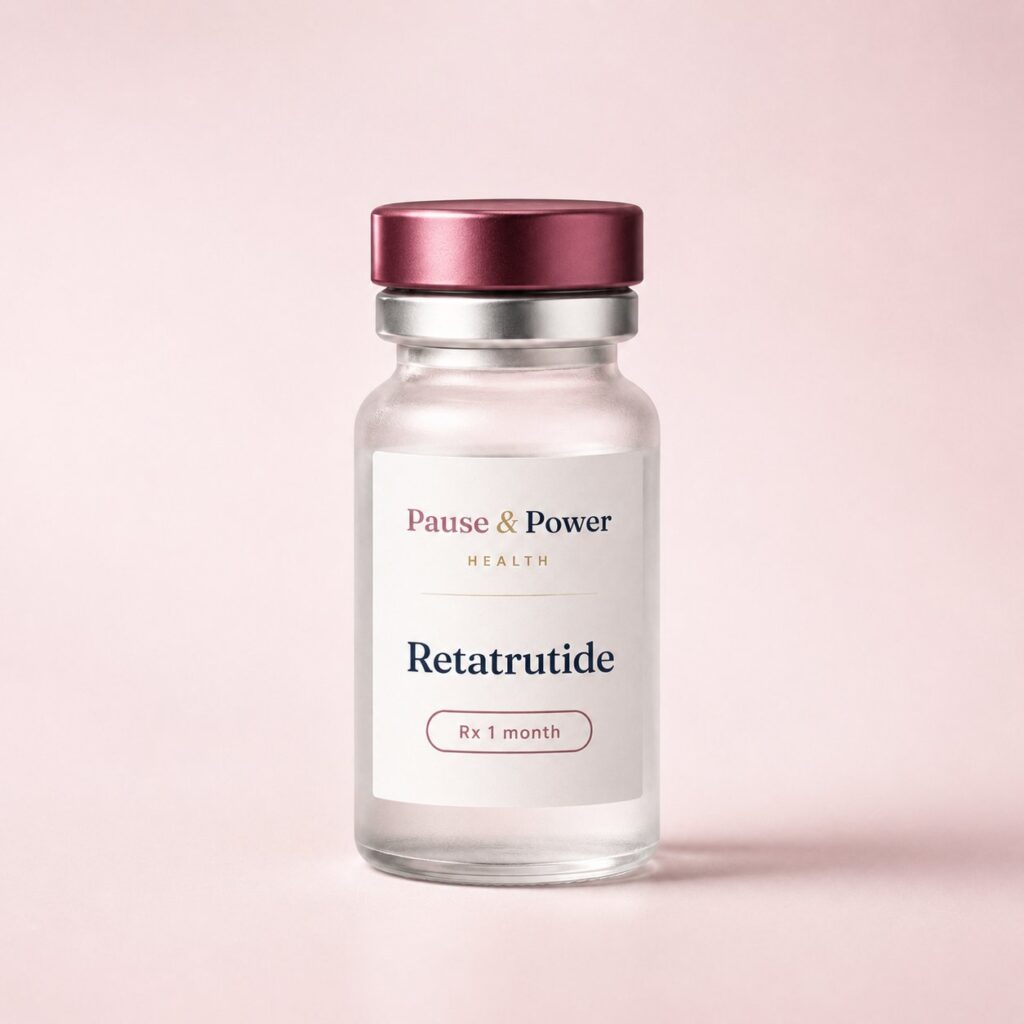
Pricing scales with your dose. See full pricing by dose →
Retatrutide is a next-generation triple-receptor agonist (GLP-1, GIP, and Glucagon) currently in Phase 3 development by Eli Lilly. Early Phase 2 results show roughly 24 percent average weight loss at 48 weeks at the highest dose, the strongest weight loss effect of any pharmacotherapy currently studied. It is compounded and prescribed off-label by select 503A pharmacies pending FDA approval of the branded product.
Subcutaneous injection one time per week using a single-use syringe. Self-administered at home after a short tutorial during your initial consult.
All patients start at 2 mg weekly. Titration moves up in 4 to 8 week intervals depending on response and side effect profile.
Retatrutide is the strongest option on our menu. Best suited to patients with significant weight to lose or who have plateaued on semaglutide or tirzepatide.
Telehealth removes the parts of traditional wellness care that waste your time. Here's how the journey starts.


Retatrutide is the strongest peptide on the menu and the highest-priced. Pricing scales with dose so titration costs stay predictable.
Your initial consult is free. Monthly subscription includes medication, sterile supplies, and ongoing clinical access. A flat $25 monthly shipping fee is added to cover delivery.
Retatrutide is the most powerful option on our menu and accordingly the most carefully prescribed. Our NP reserves it for patients with significant weight loss goals or prior GLP-1 plateaus.
Retatrutide is currently in Phase 3 development by Eli Lilly and is not yet FDA-approved as a finished pharmaceutical product. The compounded version we prescribe is prepared by a California-licensed 503A pharmacy specifically for you based on your clinical visit. This is an off-label prescription pending FDA review. Compounded medications are legal under federal and California law when prescribed for a specific patient based on a clinical evaluation.
Because retatrutide is newer than semaglutide and tirzepatide, the long-term safety profile is less established. Our NP starts every patient at the lowest dose and titrates slowly to monitor for side effects. Gastrointestinal side effects (nausea, reduced appetite, occasional vomiting) are common during titration, similar to other GLP-1 medications. We’re a message away if anything comes up.
Book a free video consult and start your Semaglutide program. Our NP reviews every new patient personally.
Eli Lilly’s branded retatrutide product is still in Phase 3 clinical trials. FDA approval is anticipated in the next 1 to 2 years pending trial completion. In the meantime, compounded retatrutide is prescribed off-label by California-licensed 503A pharmacies under standard compounding regulations. The compounded version uses the same active molecule studied in trials.
Early Phase 2 data shows retatrutide producing roughly 24 percent average weight loss at 48 weeks at the highest dose, compared to roughly 20 percent for tirzepatide at 72 weeks. The triple-agonist mechanism (vs tirzepatide’s dual-agonist) appears to produce stronger metabolic effects but also more pronounced gastrointestinal side effects during titration.
Yes. The initial 30 to 45 minute video consult with our NP is free. You only pay if you decide to start the program. There’s no obligation and no pressure if it turns out this service isn’t right for you.
No. Pause and Power Health is a telehealth program licensed in California. Patients can be located anywhere in the state, from San Diego to the Bay Area. Your video visit happens wherever you have a private space and an internet connection, and your medication ships to your home.
After your consult, our NP sends the prescription to a California-licensed pharmacy. The pharmacy ships your monthly supply directly to your home with everything you need. A flat $25 monthly shipping fee covers delivery.
Pause and Power Health is a cash-pay practice. We don’t bill insurance directly. On request, we can provide an itemized superbill that you may submit for possible out-of-network reimbursement. Most patients use HSA or FSA funds toward consultations and medications.